PFC George Dorrell Davis
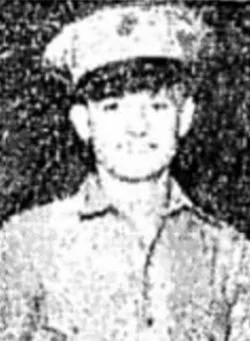
On November 4, 1922, E.V. and Bertha Davis became the proud parents of George Dorrell Davis. George was born in Hastings, Oklahoma, but the family soon moved to Pampa, Texas. George was the second of four sons. His older brother, Glenn, served in WWII as a Captain in the U.S. Army. His brother, Bobby, served in the Army in the Korean War. His youngest brother, Don, also served in the U.S. Army and was stationed in Berlin in the mid-50s.
Although Glenn, Bobby, and Don chose the Army for their military service, George was bound for the U.S. Marine Corps. On September 16, 1940, at the age of 18 and well before the United States entered the war, he enlisted in the Marine Corps. From November 1940 to March 1941, George was stationed with the Anti-Tank Platoon with the 6th Marines in San Diego, California. On April 4th, 1941, PVT Davis and a handful of his fellow Marines boarded a boat sailing to the Cavite Navy Yard in the Philippine Islands. His battalion at Cavite provided anti-aircraft and ground protection for all naval activities at the base.
On December 8, 1941 (Manila time), ten hours after the Japanese bombed Pearl Harbor, Japan launched an aerial attack on the Philippines. The series of raids caught most U.S. aircraft on the ground, destroying all B-17s at Clark Field as well as almost all of the P-35 and P-40 pursuit fighter squadrons based at Clark Field and three other bases. In less than 24 hours, the U.S. experienced devastating losses of its fleet at Pearl Harbor and the heart of General Douglas MacArthur’s Air Force in the Philippines.
Japanese bombing raids did not let up, becoming a full-scale invasion of Luzon on December 22nd. MacArthur ordered the withdrawal of American and Filipino forces to the Bataan Peninsula and then to Fort Mills, Corregidor Island. By this time, PFC Davis had been assigned to K Company, Third Battalion, Fourth Marines, which was responsible for the construction of defenses on the northeast section of the beaches on Corregidor.
E.V. and Bertha received their last letter from George about two weeks before the United States entered the war on December 7, 1941. He had just turned 19 years old. They knew he was at Bataan. It wasn’t long before they also knew that Bataan was under Japanese siege.
In January 1942, PFC Davis was moved to M Company, and in April, he was promoted to Private First Class. During these months, the defense of the Bataan Peninsula was becoming more and more hopeless. By April, all beach defenses had been destroyed. On April 29th, Japanese sorties dropped 106 tons of bombs. By nightfall, Corregidor was a “pulverized, blasted chunk of rock lying under a blanket of dust and smoke.”
On May 5, 1942, General Jonathan M. Wainwright IV knew the situation was perilous and further resistance was useless. He feared a massacre of 1,000 sick and wounded personnel and made the decision to surrender. On May 6, PFC George Dorrel Davis became a Prisoner of War of the Imperial Japanese Army.
Approximately 12,000 men (including General Wainwright) were held in the Kindley Field Garage, including all wounded. They were held for seven days without food. There was one water spigot to serve the entire camp. The Japanese soldiers robbed every prisoner of all their personal effects, including watches, eyeglasses, wallets, money, paper, and pens. Mr. and Mrs. Davis were informed that George was not reported as dead but as being held as a Japanese POW.
Two weeks following the surrender, Japanese merchant ships began transporting the POWs to Manila. They were marched through the streets in a Japanese victory parade ending at Bilibid Prison. They were then crammed into boxcars and taken to the Japanese POW camps just east of town in Cabanatuan. In July 1942, PFC Davis and 300 other American POWs were shipped to Prison Camp 10A on the island of Palawan. They worked as slave labor building an airstrip with hand tools.
On the night of August 10, 1942, PFC Davis and five other men escaped Prison Camp 10A. Their group consisted of three Marines and three U.S. Navy sailors. They made their way to a rocky beach where they found an abandoned 12-foot, outrigger-type canoe. Using found lumber as paddles, they pushed out to sea and headed south towards Australia. The vessel had terrible leaks, and the men used coconut hulls to bail water out of the canoe. They paddled all night, putting in under cover during daylight hours. Four days after their escape, they reached Brooke’s Point, about sixty miles south of Camp 10A.
At Brooke’s Point, they found friendly Filipinos and an American plantation owner. The band of escapees began working with Filipino guerrillas and participated in a number of successful attacks on parties of Japanese soldiers.
In early 1943, George and three of his fellow escapees sailed to Balabac Island and stayed on the island for quite a while, continuing to partner with guerrillas against Japanese forces. There, they heard that Americans were manning a radio outpost on the Island of Tawi-Tawi in contact with General MacArthur in Australia. They set out in a sailboat on August 1, 1943.
On August 10, 1943 – exactly one year from the day they escaped Prison Camp 10A- the four arrived on Tawi-Tawi. While there, PFC Davis and S1c Robert “Bobby” Hodges (USS Gennessee) decided to set sail for Australia by themselves. They departed Tawi-Tawi in October 1943 in a well-stocked boat.
George and Bobby were never heard from or seen again.
On January 7, 1946, PFC George Dorrell Davis was officially declared Killed in Action on an unknown date. His location of death was listed as the Philippines.